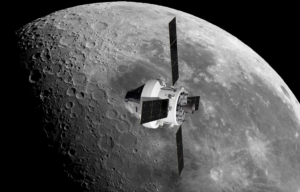
One of the Vanguard satellites in Florida in 1958. Credit: NASA
The fact that “we are all made of star stuff,” as Carl Sagan famously put it, has become fairly common knowledge by now, celebrated in movies, poems, and song lyrics. What’s generally not known is that a key confirmation of “stellar nucleosynthesis,” the creation of the heavy elements that comprise our bodies and our planet, came from the testing of nuclear weapons.

The Atomic Energy Commission certainly wasn’t detonating H-bombs to provide data for a quartet of astrophysicists, but it’s one example of the symbiotic relationship between science and the military in Neil deGrasse Tyson and Avis Lang’s Accessory to War: The Unspoken Alliance Between Astrophysics and the Military.
It may be an uncomfortable and at times contentious alliance, but it’s real, and it works in both directions: “Many significant advances in our understanding of the cosmos are by-products of government investment in the apparatus of warfare, and many innovative instruments of destruction are by-products of advances in astrophysics.”
Rife with irony, ethical dilemmas, and mutual advantage, the partnership of science and the military is far older than the technological conflicts of the 20th century. The earliest telescope, for example, was intended by its inventor Hans Lipperhey in the 17th century not for contemplating the heavens but for scanning the horizon for enemies, the key point of his sales pitch to the Dutch military forces then embroiled in the 80 Years’ War. His instrument was “very useful in sieges and similar occasions,” an insider’s account enthused.
Lipperhey’s telescope, “marketed to the Chiang Kai-sheks and Benito Mussolinis of their era, not to the Carl Sagans and Stephen Hawkings,” was soon after refined and deployed by Galileo for the more noble tasks of discovering the moons of Jupiter and the craters of the Moon – though he also wasn’t above seeking the patronage of the Venetian authorities by extolling the virtues of his improved instruments for sighting approaching enemy warships.
Also read: The Sixth Dimension of War: A Battle For the Mind
Then as now, the aims of astrophysics and warfare are hardly as disparate as they may seem, as Tyson and Lang explain in sometimes exhaustive detail. Critical to both endeavours is light, or more precisely, electromagnetic radiation: detecting it, locating it, analysing it, recording it and generating it, both actively and passively, across the entire spectrum from radio waves through infrared, visible light, ultraviolet, X-rays, and gamma rays. “It’s how the contemporary astrophysicist — and the contemporary warfighter — wants to use the light that makes all the difference,” note Tyson and Lang. All of those wavelengths have become sub-disciplines of astronomy, but sometimes the military got there first.