Author: Nihar Gokhale

  • Govt Ignored NTCA Warning That Sagarmala Plan Is Bad For Western Ghats Biodiversity

    Govt Ignored NTCA Warning That Sagarmala Plan Is Bad For Western Ghats Biodiversity

    A tiger in Karnataka. Photo: gskep-photo/Flickr, CC BY NC ND 2.0

    In February 2021, the environment ministry issued its in-principle forest clearance to the Indian railways for adding a second track to the railway line connecting Goa and Karnataka. The track goes through dense forests of the Western Ghats, including the Kali Tiger Reserve in Karnataka and forests near Mollem in Goa. The clearance allowed officials to fell at least 22,000 trees in the forests.

    Now, a petition challenging the project in the Karnataka high court has presented government records that suggest that the approval to the project had ignored warnings by the National Tiger Conservation Authority (NTCA), the government agency tasked with protecting tigers, over the project’s impact.

    The NTCA report from July 2020 had said that the project could affect prime tiger habitat and “damage the integrity of the last remaining wilderness of the Western Ghats”. The report had criticised the environmental impact assessment of the project, done by researchers at the Indian Institute of Science, Bengaluru, as being biased to the railways, and said that the Railways plans to cut down more trees than it had declared in its clearance application.

    The records further show that these observations of the NTCA were suppressed by the NTCA’s own headquarters, which presented only a short version of the report to the National Board for Wildlife, which eventually issued wildlife clearance to the project in January 2021.

    A.N. Yellappa Reddy, an 84-year old retired forest officer from Bengaluru who was involved in the decision to notify Anshi National Park – now a part of the Kali Tiger Reserve – filed the petition in the high court on April 23. Reddy retired in 1995 as secretary, department of ecology and environment, in the Government of Karnataka.

    On April 23, the Supreme Court’s Central Empowered Committee recommended that the court cancel the project, stating that its ecological costs outweighed any benefits.

    The National Tiger Conservation Authority and the National Board for Wildlife did not respond to questionnaires sent on April 16 about why the full site inspection report was not provided to the board, and why the board did not ask for the full report either.

    The Railways project is one of those being opposed by the Save Mollem campaign in Goa. Hundreds of Goans staged an overnight sit-in on the railway tracks in November 2020. The project is funded by the Centre’s ‘Sagarmala’ programme as a ‘port connectivity’ scheme to connect the Mormugao Port in Goa with Karnataka. The port has described the completion of the railway project as a “very big factor” in its future growth, as it will expand the transport of imported coal to steel and power plants in Karnataka.

    In recent years, a dozen such projects of the Central government, including highways, power transmission lines and railways projects, have been proposed in a narrow stretch of the Western Ghats in Goa and Karnataka. There is growing evidence that these projects have not been adequately scrutinised by the environment ministry and that warnings in site inspection reports by field-level forest officers have been ignored.

    A railway track in the Western Ghats. Photo: NTCA report

    Site inspection report

    The NTCA’s site inspection report resulted from a request from the National Board for Wildlife’s standing committee in July 2020. Under Section 38O(1)(g) of the Wildlife (Protection) Act, 1972, NTCA is to ensure that projects coming up in tiger habitats are not for “ecologically unsustainable uses except in public interest and with approval of the National Board for Wild Life.” After the Board’s request, the NTCA formed a site inspection committee consisting of Rajendra G. Garawad, the NTCA’s then assistant inspector general of forests in Bengaluru, along with the field director of Kali Tiger Reserve Maria Christu Raja D., and general manager of Rail Vikas Nigam Limited B. Chandra Sekhar.

    The report, submitted to NTCA headquarters in July under Garawad’s signature, features photographs of the sites covered in monsoon mist with dense forests and steep cliffs on either side of the existing single-track railway line. It also features photographs of snakes lying dead on the tracks and local forest department records of elephants and bison killed by trains.

    The report criticised the environment and biodiversity impact assessment report for the project prepared for the railways by the Indian Institute of Science professors Raman Sukumar and T.G. Sitharam. The impact assessment “lacks in critical assessment particularly of project impacts and merely reiterates project proponents’ views,” the NTCA’s report said. Out of 230 pages, mitigation measures covered a “mere six pages” and these too were “fairly generic in nature” that did not take into account “ground realities” and some suggestions, like joint patrolling by railway and forest staff to monitor wildlife presence, were “impractical and theoretical in nature,” the NTCA report said.

    The report also said there was a conflict in interest as professor Sukumar was also a member of the National Board for Wildlife, which assesses such projects for wildlife clearance.

    The project may have an even greater impact on forests than currently estimated, the report said. This is because the Railways’s forest clearance application does not include a 15-metre wide strip of land along the existing route that the Railways says it owns but which has dense forests of high ecological value.

    Also Read: ‘Magical Mollem’: A Film on Goa’s Dying Green Heart

    The report pointed towards the ongoing widening of National Highway 4A, which also connects Goa to Karnataka, passing “within an aerial distance of 5-6 km” in “one of the most ecologically
    sensitive and biodiversity-rich part of Western Ghats.” The projects “will definitely have far reaching implications for the wildlife due to habitat destruction, disturbance, habitat fragmentation, road kills and train collisions,” the report said.

    The site visit report concluded with recommendations, including carrying out a feasibility study of the mitigation measures suggested in the impact assessment report, and a cumulative impact study and cost-benefit analysis of the railways project along with the NH-4A widening.

    A Bengal tiger in the Western Ghats. Photo: Hollingsworth, John and Karen/Wikimedia Commons, Public Domain

    NTCA headquarters excludes sections

    The site visit report was submitted on July 21 to the headquarters of the NTCA in New Delhi. NTCA records show that on the next day, the NTCA issued an office memorandum containing its advice under Section 38O(1)(g) of the Wildlife (Protection) Act.

    But this advice did not convey most of the issues raised by the site inspection report, including issues with the impact assessment report, the risk to the Western Ghats, the underestimation of the impact on forests, the cumulative impact of the railway project along with nearby NH-4A widening work.

    The NTCA conveyed only one recommendation, and that too was not mentioned in the site inspection report at all. The recommendation called for “a detailed study prescribing mitigation measures in this difficult terrain.” But the site report had instead called for “a detailed study of feasibility of mitigation measures in this difficult terrain” (emphasis added). The recommendation said that the study “should focus on structural and non-structural mitigation measures” – which the site report had neither recommended nor mentioned.

    The National Board for Wildlife’s standing committee in October 2020 asked the Wildlife Institute of India to carry out the study prescribing mitigation measures as recommended by the NTCA headquarters. The meeting minutes do not say if the panel saw or discussed the site inspection report.

    The NTCA should have submitted the full site inspection report to the Board, said Praveen Bhargav, managing trustee of Bengaluru-based non-profit Wildlife First and a former member of the National Board for Wildlife. “After spending public money to carry out the site inspection it becomes mandatory for the NTCA to present the full site inspection report,” Bhargav told The Wire. “It also is the responsibility and duty of the standing committee [of the Board] to insist on filing of the full report.”

    “The NTCA report is explicit and emphatic on the heavy ecological costs of the project; it has clearly stated the need for an independent and detailed assessment of the cumulative impacts of the project,” Prerna Singh Bindra, author, wildlife conservationist and former member of NBWL told The Wire. “The issue here is not the availability of the report – all such documents pertaining to a project under consideration, are made available to the Standing Committee of the NBWL,” Bindra said. “The issue here is – has the NTCA report weighed in the decision of the SC, NBWL, and has the report been given the due diligence it deserves?”

    Professor R. Sukumar, a member of the NBWL, told The Wire that he had not seen the NTCA site inspection report. The minutes of the NBWL meeting in January 2021, when the project was discussed and approved, do not mention the site inspection report but only the final submission.

    Sukumar also denied the conflict of interest mentioned in the site inspection report, saying he had been commissioned by the railways to prepare the project’s impact assessment report one year before he was appointed to the Board.

    On the report’s claim that mitigation measures did not take into account “ground realities”, Sukumar responded that “ground ‘realities’ can change over time,” and that patrolling to avoid wildlife collisions with trains is a practice in West Bengal and is also not the only solution.

    Sukumar did not offer specific responses to allegations in the report about the quality of the impact assessment, only saying that the impact assessment covering the railway track from Castlerock to Kulem (which covers the most dense forests) was “reviewed by the Goa Forest Department and their comments [were] taken into account.”

    Sukumar recused himself from the NBWL meeting when the project proposal was considered and approved, according to the minutes of the meeting.

    The NTCA’s suppression of the site inspection report shows that it was a “mala fide” decision of the government, Sreeja Chakraborty, the counsel in the high court petition, told The Wire. “Any administrative decision which is mala fide is illegal because it vitiates the decision-making process. It deserves to be struck down by the courts under judicial review,” she said.

    Also Read: The Two Tigers That Make the Case for India to Protect Its Wildlife Corridors

    WII’s study in too short a time

    The recommendation that was passed on by NTCA – for a study prescribing mitigation measures – was eventually carried out by the Wildlife Institute of India. But not without controversy.

    The introduction to the WII’s report mentions that in August 2020, the deputy inspector general (wildlife) of the environment ministry told WII to complete its study “within three weeks”. But WII responded saying it required more time, and also financial assistance. The correspondence apparently ended there.

    On October 20, 2020 at the NBWL’s standing committee, which discussed the project, asked the WII director to conduct the study “within two months”. That is when WII submitted a formal proposal, and upon receiving financial assistance it initiated its study in November.

    The study was conducted over just 15 days from November 19 to December 5, 2020. The WII report says that this was a “rapid survey” conducted “over a short period”. The report said that since this was a “non-breeding season” its inventory of species was “far from complete” and “perhaps just representative and not exhaustive.”

    The WII recommended several dozen mitigation measures including culverts and bridges at several dozen locations along the rail route, as well as fencing along the full route to prevent animals from being hit by trains. In the few openings in the fencing, the WII recommended detectors that could automatically warn a train of wildlife crossing the track. It also recommended canopy bridges every one kilometre to allow monkeys and other arboreal animals to cross the track from above.

    On April 5, a group of 30 wildlife scientists wrote to the WII raising concerns with its mitigation measures. Their letter said that the measures “are not based on rigorous scientific data and lack information in several aspects.” The letter said that “the rapid manner in which the study seems to have been conducted raises doubts about the accuracy and reliability of the data and the ensuing mitigation measures suggested.”

    Evergreen forest of the Western Ghats. Photo: NTCA report

    Inadequate assessments in Western Ghats projects

    Records available on the environment ministry’s green clearance tracker show that over 12 linear infrastructure projects are currently proposed or coming up in the Western Ghats in Goa and Karnataka. These projects include the widening of the National Highway 4A, National Highway 766E, a new railway line from Hubli to Ankola in Karnataka and three power transmission lines.

    The records consist of site inspection reports by field-level officers that warn of damage to biodiversity. But these find no mention in approvals issued by senior officials and bodies like the NBWL (also available on the website).

    A critique of three of these projects, including the railways double-tracking, published by 30 scientists in the Journal of Threatened Taxa says that impact assessments of the projects were “considerably weak and evidently overlooked” by authorities.

    Bhargav said that linear intrusions need to be carefully analysed from various angles such as distance between parallel alignments, utilisation levels and measures to improve utilization of existing infrastructure.

    “Unfortunately, a slew of redundant parallel alignments of highways and railways are being pushed through in the ecologically sensitive Western Ghats without due application of mind,” he said.  “This puncturing of the Western Ghats every five to ten km must stop.”

    Nihar Gokhale is associate editor at Land Conflict Watch, an independent network of researchers studying land conflicts, climate change and natural resource governance in India.

  • Critical Wildlife Habitats Advisory Augurs Future Conflicts in National Parks

    Critical Wildlife Habitats Advisory Augurs Future Conflicts in National Parks

    A tiger at the Ranthambhore Tiger Reserve. Photo: Koshy Koshy/Flickr, CC BY 2.0

    On September 7, India’s environment ministry sent an advisory to state governments asking them to ensure the implementation of one clause in the Forest Rights Act: the creation of critical wildlife habitats.

    Critical wildlife habitats (CWHs) are areas inside wildlife sanctuaries, national parks and tiger reserves – known as ‘protected areas’ – where people’s activities like cattle grazing or collecting leaves compete with the needs of wildlife.

    The Forest Rights Act, passed in 2006, recognises traditional land rights of millions of Adivasis and forest-dwellers, including nearly four million who live inside protected areas.

    The Act defines CWHs as areas that are “required to be kept as inviolate for the purposes of wildlife conservation.” Such areas are determined for each protected area by a committee which has scientists, local people, and a representative from the Ministry of Tribal Affairs.

    The committee decides whether the communities and wildlife could co-exist by making changes to their forest rights, say by restricting cattle grazing in certain pastures. Communities can be evicted if people’s presence or activities could cause “irreversible damage and threaten the existence” of wildlife.

    No CWH has been declared so far in any of the 500-plus protected areas in India. Approximately 2 million individual and community land titles have been recognised so far, including in protected areas.

    Wildlife conservationists said that the ministry’s advisory, which has not been reported in the press so far, was good because states have so far ignored the provision while implementing others. “State governments are happy to grant rights to voters in protected areas but they won’t give justice to wild animals as wild animals can’t speak and vote. Rights were denied to wildlife in last 13 years of the FRA,” said Kishor Rithe, founder of Satpuda Foundation in Amravati, member of the Maharashtra State Board for Wildlife, and a member of the CWH demarcation committee for Melghat Wildlife Sanctuary.

    But forest rights activists and social scientists worry that the advisory could lead to evictions and land conflicts in wildlife sanctuaries and national parks across the country.

    Also read: For India’s Wildlife, the Lockdown Isn’t the Good News Many Think It Is

    To implement CWHs effectively, state governments need to first recognise all rights under the FRA, hold consultation with gram sabhas and then understand “inviolate” areas as areas with minimum human impact and not free of human presence or use, said Neema Pathak Broome, who coordinates the Conservation and Livelihoods program at environmental non-profit Kalpavriksh and is the co-author of a recent study on CWHs.

    “There is a concern that without following these steps there will be a push for relocation programs in protected areas in the name of creating CWHs,” she said.

    The worry stems in part from the process that the Maharashtra government followed since 2018 to implement CWHs in the state. It is the first and only state to do so. The state high court halted the CWH process in late 2019 after a government panel found that forest rights had not been recognised or being illegally rejected. Many CWH committees included people without sufficient knowledge of the law or with a history of opposition to the FRA like Rithe.

    There are also concerns that the Critical Wildlife Habitat guidelines of 2018, based on which the process would be done across India, were prepared without any public consultation and could be misused to evict forest dwelling communities.

    Soumitra Dasgupta, Additional Director General of Forests (Wildlife), who issued the advisory, did not respond to calls for comment.

    Baiga Adivasis in a protest walk. Credit: Wikimedia Commons

    Wildlife habitats 

    In the mid-2000s when the Indian government was drafting the Forest Rights Act, some groups raised concerns about what impact the recognition of the rights of forest dwellers could have on the wildlife.

    Around that time, conservation researchers, as well as the International Union for Conservation of Nature, had also begun to recognise the role played by indigenous communities played in protecting forests. The idea behind the CWH was to enable a scientific process that is transparent and can be justified in public with evidence, says Shankar Gopalakrishnan of the Campaign for Survival and Dignity, a network of forest community organisations that lobbied for the creation of the Forest Rights Act.

    However, the implementation of CWHs remained stuck for years as the environment ministry could not finalise the CWH guidelines. The ministry had issued the first draft guidelines for CWHs in 2007 and revised them in 2011.

    These draft guidelines made several errors, such as by confusing CWHs with critical tiger habitats (a provision under Wildlife (Protection) Act, 1972) and by assuming that CWHs would automatically lead to relocation of communities, said Ravi Chellam, an expert on Asiatic lions and chief executive of the Metastring Foundation, Bengaluru.

    Also read: The Centre’s Exclusionist View of Conservation Is Increasingly Counterproductive

    The ministry finalised the guidelines after a long gap of seven years in 2018. These guidelines corrected some of the errors from before, Chellam said, such as by clarifying that relocation of communities could be done only if other options were not workable.

    But unlike for its previous draft guidelines, this time the environment ministry did not carry out any open consultations, not even with the Ministry of Tribal Affairs, which is responsible for monitoring the implementation of the Forest Rights Act.

    The guidelines still left out crucial parts related to coexistence. “The CWH guidelines need to satisfy the requirement that you must show “irreversible” harm to wildlife in CWH. The guidelines do not state what that evidence should be,” said Gopalakrishnan.

    “The law says that instead of being demarcated on the basis of bureaucratic fiat, the CWHs should be based on a scientific process and that process should be transparent. You should have to justify it to the public and especially the affected community. The guidelines don’t address this. So once again it leaves these in the hands of the forest department.”

    The environment ministry’s advisory now appears to go against its own guidelines.

    Under the Forest Rights Act and the CWH guidelines, CWH demarcation can begin only once all possible rights are recognised.

    At least 511,000 claims are in process, according to Ministry of Tribal Affairs data, and another 1.7 million previously rejected claims are under review as per a Supreme Court order. Just about 13% of the total potential area under traditional rights has been estimated to be recognised under the Act.

    The advisory gives a “clear hint” to start the CWH process side-by-side with recognising forest rights, said Sharachchandra Lele, Distinguished Fellow in Environmental Policy and Governance at Ashoka Trust for Research in Ecology and the Environment (ATREE), Bengaluru.

    Lele explained that after a community’s forest resource rights are recognised, it has to prepare a CFR management plan that describes how they will exercise these rights, which includes the extent of grazing and other activities, and steps they will take to conserve the forests and wildlife.

    “For all you know the community’s management plan might automatically address the objective of wildlife conservation,” Lele said.

    The advisory “is perverting the whole logic of the Act [FRA],” he said.

    The case of Melghat Wildlife Sanctuary

    Maharashtra government began the process of creating CWHs in 2018, triggered by the petition that Vanashakti, a Mumbai-based NGO filed in the Bombay high court in 2014 seeking an order for the Maharashtra government to implement CWHs across the state’s 54 sanctuaries.

    As per the Forest Rights Act, expert committees are formed under CWH provisions for each wildlife sanctuary and national park, which analyse whether or not coexistence between people and wildlife is possible.

    Also see: An Interactive Guide to the Projects the Wildlife Board Cleared During the Lockdown

    According to the environment ministry, each committee should have three government representatives, the village head, and three non-government members, which include one social scientist and two experts in life sciences like ecology, zoology, botany, and wildlife sciences.

    On October 25, 2019, the committee of Melghat Sanctuary issued a public notice that it will begin consultations in all the 14 villages in the sanctuary. But the committee has no social scientist as required by the CWH Guidelines.

    Its three non-government members include Kishor Rithe of Satpuda Foundation, who is also the representative of the non-profit Nature Conservation Society in an ongoing Supreme Court petition seeking to strike down the Forest Rights Act as being unconstitutional.

    “A person who does not believe that the FRA is constitutional cannot be expected to participate and implement any of its provisions, especially highly sensitive provisions such as the CWH, with objectivity,” reads an August 2020 report on the CWHs jointly prepared by ATREE and non-profit Kalpavriksh.

    Rithe rejects this claim. “Looking at my long experience of working in protected areas on both wildlife and tribal issues, I find myself fit to work on this committee which was set up by the Government,” he told me.

    Melghat Tiger Reserve, tribal people, buffer zones, forest department, Wildlife Trust of India, National Commission for Scheduled Tribes, National Tiger Conservation Authority, Maharashtra, Satpuda Foundation, State Reserve Police Force,
    Melghat Tiger reserve is home to many important species of flora and fauna. Photo: Bendale.kaustubh/Wikimedia Commons, CC BY-SA 3.0

    Two weeks after the CWH committees issued the notice in October 2019 to begin consultations in the 14 villages of Melghat Santuary, Maharashtra’s tribal development department formed a panel under Vinoba Patil, the department’s Additional Tribal Commissioner for Amravati district where the sanctuary is. The panel was asked to ensure that the CWH process in Melghat follows procedures in the FRA.

    On November 9, the panel gave a preliminary report to the tribal department that the CWH work began before the complete settlement of rights of the communities in the villages. Community forest rights claims of ten villages had been illegally rejected on the grounds that they were inside a protected area. This is not one of the grounds on which a title claim can be rejected as per the FRA. Their appeals were pending. Two villages were yet to file their claims.

    The panel recommended suspending all CWH activities until the recognition of forest rights was completed. On 18 December 2019, based on an application filed by KHOJ, a non-profit in Melghat, the Bombay high court halted the CWH recognition process in Melghat until all the FRA claims were settled.  The court gave the Maharashtra government three months to complete this process.

    The panel conducted field visits in Melghat in January 2020, it found that the local administration was still illegally rejecting many FRA claims or recognising them on a smaller area than the people claimed.

    On 5 August 2020, the District Level Committee headed by Amravati district collector rejected the community forest rights applications of two villages, Pastalai and Mangia in Melghat Sanctuary. Following this, the gram sabha of Pastalai filed an appeal against the rejection before the Divisional Commissioner, the final appeal under the Act in Maharashtra (in other states, the District Level Committee is the final appeal body).  One month later, the forest department began arresting people and their cattle, and creating “an environment of unrest and uncertainty in the village,” according to a complaint KHOJ filed with the Maharashtra tribal development department.

    Also read: Study Finds 13,450 Families Living Near Protected Areas Displaced Since 2000

    The tribal department wrote to the Amravati district collector the next day to stop any evictions until the appeal before the Divisional Commissioner was concluded. But the evictions did not stop.

    On November 9, Patil, who had headed the state monitoring panel, told the forest department that its officers and local police were “intimidating villagers” in at least four villages and “forcing them to relocate”. “Such action was not expected,” Patil wrote, reminding the forest department about the requirement for declaring CWHs as laid down in the Forest Rights Act and the state high court’s orders about not evicting anyone until their forest rights application process concludes.

    The next day the divisional commissioner issued orders to stop evictions in Pastalai until their appeal was concluded.

    A broader problem

    Across Maharashtra, many CWH expert committee members said they had no idea what the provisions really meant, and they were given no background, said Lele from ATREE, who was also a member of the tribal department panel. “It was treated as a given that wildlife conservation requires pristine areas, that pristine means people have to be evicted, and that CWH provisions allow us to declare which part of the protected area is to be kept pristine.”

    “You can’t measure all wildlife sanctuaries by the same yardstick while discussing the issue of ‘coexistence’ and ‘inviolate’,” said Rithe of the Satpuda Foundation. “You need to understand ground realities. The bird sanctuaries notified to provide protection and conservation of Great Indian Bustard (GIB) and Lesser florican can very well coexist with human habitations because these birds feed in agricultural lands and surrounding grasslands,” he said.

    “But if you talk about protected areas which are homes to tigers, you can’t think of people co-existing with Tigers. So you need to treat every PA on a scientific and case by case basis,” he said.

    The ATREE-Kalpavriksh report had said that across Maharashtra, the expert committees did not have social scientists and that experts in life sciences were replaced by “local wildlife enthusiasts.” Based on that finding, the report recommended that the local CWH committees needed to be retrained because their task was “extremely challenging and complex, requiring detailed assessment, consultation, adherence to due process and transparency, use of scientific data and inclusion of traditional knowledge.”

    A male Lesser Florican Sypheotides indicus from Rajasthan, India. Photo: Angad Achappa/Wikimedia Commons, CC BY-SA 4.0

    The report also warned that past experience of forest-dwellers in a sanctuary is “not a good guide to what will happen in the future”. That is because the past behaviour took place when people were under the threat of eviction. Once secure rights are granted over well-defined areas the likely effects on wildlife has to evaluated afresh, the report said.

    “In theory, this would require monitoring the impact of the activities of the Gram Sabhas over (say) a five year period,” the report says.

    “Of course, wildlife has rights,” said Pathak-Broome of Kalpavriksh. “But many of the areas being declared CWH are areas where local communities have lived for generations and followed lifestyles which are much more conducive to wildlife. Far more than people like us who may talk about the rights of wildlife but whose consumption levels, lifestyles, and definition of ‘development’ are causing havoc and destruction of wildlife in all landscapes.”

    Also read: India’s National Board for Wildlife Is a Big Threat to India’s Wildlife

    A bottom-up solution to an old problem

    Wildlife conservation began with a “top-down” idea of creating ‘protected areas’ that kept humans outside. Globally most protected areas came up on lands that indigenous people inhabited for generations. But they were still evicted from there without compensation. The ensuing criticism led to a second wave of conservation where governments began offering compensation in terms of money or alternate land to the evicted communities.

    Provisions like CWH are part of a growing recognition of the historical land rights of indigenous peoples among some conservationists and governments. CWHs also represent an emerging understanding that keeping forests free of humans is not necessary to preserve wildlife, conservation experts say.

    The CWH provisions could represent a new wave of a “bottom-up” approach of wildlife conservation, said Amrita Neelakantan, a conservation scientist who recently completed a doctoral thesis at the Columbia University on the resettlement of communities from the Kanha National Park in central India.

    But ground realities are such that villages have little autonomy in making decisions and people do not have the agency necessary to exercise their rights, said Neelakantan, the conservation scientist. “People living in sanctuaries are usually poor and vulnerable and want schools where a teacher shows up. They are thinking two years ahead. So when there is a choice to relocate outside to a piece of land that is near a hospital, school or an upcoming factory, people end up making that choice,” she said. “So it is also important to build agency from the ground up.”

    “Whether people have agency or not doesn’t mean you can take their agency away,” Gopalakrishnan told me. “The point is that the process [to demarcate CWHs] is transparent and open to public scrutiny, and that is all that is required.”

    CWHs can be declared properly only after its essence is understood by all those who will be involved in the process, else the forceful and illegal eviction of the communities will go on unchecked. Gopalakrishnan says, “there is a growing consensus among conservationists that wildlife conservation is effective in the long run only if it is democratic. When it is rooted in the community and not against them.”

    Nihar Gokhale is an independent journalist and policy researcher with Land Conflict Watch, an independent network of researchers documenting ongoing land conflicts across India.

  • As NCR Sputters, 1981 Law to Fight Air Pollution Gathers Dust

    As NCR Sputters, 1981 Law to Fight Air Pollution Gathers Dust

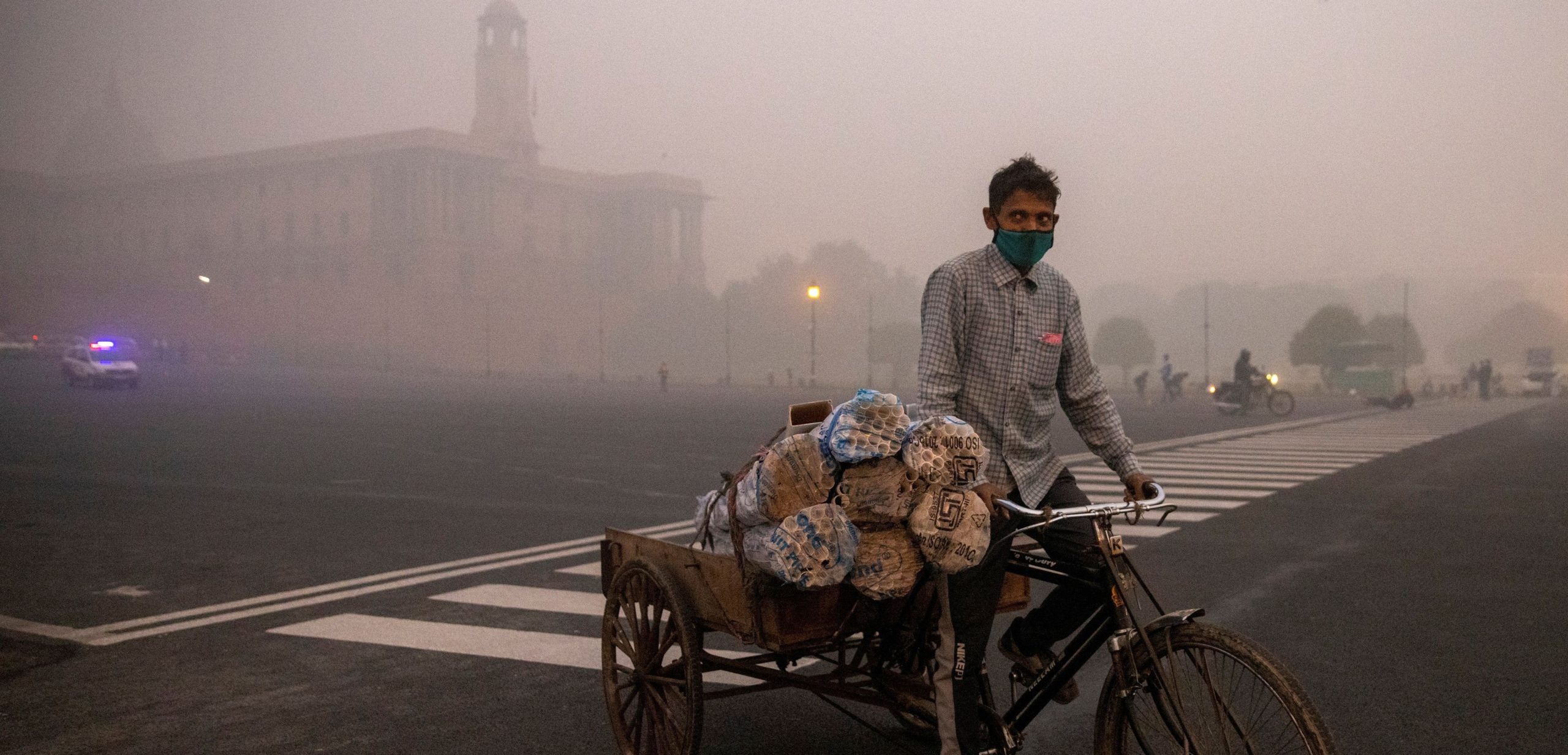
    A man transports goods on his cycle cart near the parliament on a smoggy morning in New Delhi, India, November 10, 2020. Photo: Reuters/Danish Siddiqui

    Almost 40 years ago, India passed a law to control air pollution. However, as northern India suffers another air pollution emergency, it is yet another year of reckoning for the law that is all but forgotten.

    The Air (Prevention and Control of Pollution) Act, 1981, aims to enable the “preservation of the quality of air and control of air pollution.” It was enacted to fulfil India’s commitments at the 1972 United Nations environment conference. The law gave sweeping powers to state and central governments to take action to improve air quality, enforce pollution control measures, shut down errant industries, and send polluters to jail.

    Over the years, however, the law has seen a decline in its relevance, even as Indian cities climbed to top positions in global air pollution assessments, the latest being the State of Global Air 2020. Almost zero cases have been filed under the Air Act from northern Indian states in recent years, even though they face the worst pollution every winter. Even the Supreme Court and governments have ignored the law; measures like the Graded Response Action Plan or the Odd-Even scheme rely on other laws or regulations, some of which have nothing to do with the environment.

    The law is commonly described as “toothless”. As pollution spikes in the winter season, parliamentarians, lawyers or activists demand amendments to it or to replace it with a new law, usually to add powers of enforcement. This year, it was the Solicitor General of India’s turn to make a similar promise. On 28 October the government of India enacted the Commission for Air Quality Management in National Capital Region and Adjoining Areas Ordinance, 2020 to set up a panel to coordinate the air pollution response between state governments of Delhi, Haryana, Punjab, Rajasthan, and Uttar Pradesh.

    “If you have good bureaucracy they can actually implement even without law. We are unnecessarily focusing on new laws but we are not focusing on a new bureaucracy with a different attitude towards governance,” said Sairam Bhat., who is professor of law at the National Law School of India University, told Mongabay-India.

    Also read: Why Isn’t Science Part of the Fight Against Air Pollution in India?

    Experts note that beyond the lack of powers there is an ignored need to bring the Air Act up to date with modern sources of pollution. And though the Air Act may be old, it certainly has a few sharp teeth left if the government is willing to bite.

    The Air Act came about during the heyday of environmental rule-making in India, when the Centre – first under Indira Gandhi and then her son Rajiv Gandhi – passed the Wildlife (Protection) Act, 1972, Water (Prevention and Control of Pollution) Act, 1974, Forest (Conservation) Act, 1980 and the Environment (Protection) Act, 1986. It was passed to comply with promises made at the landmark UN Conference on the Human Environment held in Stockholm in 1972 where Indira Gandhi had delivered a celebrated speech connecting poverty with pollution.

    The Water Act of 1974 was India’s first pollution control law, and it had created monitoring agencies in the states and at the centre. The Air Act converted these into Pollution Control Boards with a wide range of powers over industrial activities including the power to conduct search and seizure operations and take samples. They can also order a factory to stop operating or cut its electricity and water connections.

    For instance, no industry can be set up without permission from these boards. Industries need separate permission to start operations, and another for every time there is a change to the production process. Every permission contains instructions to install pollution control devices, put up pollution monitors, display latest pollution levels on a notice board, etc.

    The pollution control boards can also file criminal cases against factory owners or employees who may end up spending up to seven years in jail for causing air or water pollution.

    “The law applies to industries and other point sources of pollution that may not require environment clearance under the EIA Notification, such as small and medium enterprises,” Shibani Ghosh, an environmental lawyer and fellow at the Centre for Policy Research who has authored a note on the liability framework in the Act, told Mongabay-India. “In that sense, the regulatory reach of the Air Act is wider (than other environmental laws like the EIA Notification),” Ghosh said.

    Also read: NCR’s New Commission on Air Quality Isn’t Designed To Fix Air Quality

    Many sources of pollution not covered

    One of the criticisms of the Air Act has been that it has mainly focused on large and obvious sources of pollution like factories and power plants and did not cover dispersed sources of pollution like landfills, agricultural fields, vehicles and households – which have emerged as sources of air pollution.

    For example, a study by the Indian Institute of Technology, Kanpur in 2015 said that dust was probably the biggest polluter.

    Farmers in Punjab set fire to paddy stubble at the end of the Kharif or monsoon sowing season. This is one of the major sources of air pollution that the Air Act did not envisage. Photo by Neil Palmer (CIAT)/Flickr.
    Farmers in Punjab set fire to paddy stubble at the end of the Kharif or monsoon sowing season. This is one of the major sources of air pollution that the Air Act did not envisage. Photo: Neil Palmer (CIAT)/Flickr.

    When the law was framed and passed in 1981, these were just not areas of concern, Ghosh said, and the Act has not been amended to respond to the evolving ground realities.

    The law has also not kept up with new ways of measuring air pollution. For example, every ‘red’ category factory – which has the highest potential for pollution – is required to install an internet-connected emissions monitoring system. The data goes straight to the pollution control board but the data itself does not qualify as legal evidence under the Air Act.

    The law still requires samples to be physically collected by officials and analysed in an accredited laboratory. So even if the emissions system shows excessive emissions, the board cannot use it as evidence to file a case against the factory.

    These add to the difficulties already faced in gathering air evidence. “If there is an effluent flowing in the water, one can show it. But air is difficult – you cannot trap air in a container and produce it as evidence,” said Sairam Bhat.

    Bhat said that in the early years, the pollution control boards were enthusiastic about prosecuting polluters, leading to landmark cases like Mahabir Coke Industry (1998). But soon these cases fell through, and the pollution control boards lost interest in filing them.

    In the last few years, just a few dozen cases were filed across India under the Act, according to annual crime data published by the National Crime Records Bureau. Most of these cases were from a single state. States like Delhi registered zero cases. Since 2017, the NCRB has combined data of the Air and Water Acts making it hard to make sense of the numbers, such as a nine-fold spike in 2019.

    Also read: Not Just a Committee – We Need the Whole Govt To Address Stubble-Burning

    It’s not just the lack of cases. Both courts and governments have also not relied on the law to regulate air pollution. For instance, the Bharat Stage-VI engine standards and Pollution-Under-Control (PUC) certificates to vehicles are under the Motor Vehicles Act. Waste burning rules are issued under the Environment (Protection) Act; the same Act has been the basis of court judgements on issues of air pollution.

    In 2014, the T.S.R. Subramaniam committee set up by the environment ministry to evaluate environmental laws said that the Air Act should be repealed and its provisions subsumed under the Environment (Protection) Act.

    Air pollution in Delhi on November 13, 2019. Photo: PTI

    In 2015, the ruling Bharatiya Janata Party’s Feroze Varun Gandhi tabled a Bill to amend the Air Act in order to bring uniform emission standards for four-wheelers across the country. In 2018, the Biju Janata Dal’s Prabhas Kumar Singh tabled another Bill to make it compulsory to have air quality monitoring stations in towns with a population over 100,000 and in areas notified as mining or industrial towns. Both the bills lapsed.

    In November 2019, Congress MP Gaurav Gogoi promised to bring another bill with more wide-ranging changes to the Air Act, such as greater powers to the Central Pollution Control Board and involvement of the prime minister’s office in meetings. Gogoi, however, did not introduce the Bill.

    Still good enough

    However, the inadequacies in the law also hide the fact that many of its provisions have not been used. In 2016, the Centre for Science and Environment published a study of air pollution laws that found that the Air Act and the Environment (Protection) Act were “more than adequate” to improve air quality. Citing opinion from law firm Luthra & Luthra and B. Sengupta, a former member-secretary of the CPCB, the note said that the Air Act could be interpreted to control stubble burning and vehicular emissions.

    The study found that often state boards ignored directions issued by the central board, and many state boards have not even prepared clean air action plans.

    Central board’s current member-secretary Prashant Gargava, who is an expert on air pollution control, did not respond to requests for an interview.

    “Every generation wants a new aspirational law,” said Sairam Bhat of NLSIU. “But there is nothing substantial to suggest that the current legislation is inadequate. The point is about enforcement,” he said.

    This article was originally published on Mongabay.

  • Is India’s First Round-the-Clock Renewable Energy Contract Really What it Claims to Be?

    Is India’s First Round-the-Clock Renewable Energy Contract Really What it Claims to Be?

    Featured: Representative image of solar panels. Photo: Beyond Coal & Gas Image Library/Flickr (CC BY-NC 2.0)

    In May 2020, India claimed to have reached a historic milestone in renewable energy. The central government awarded a contract for the supply of 400 megawatts of solar and wind energy. Unlike other such contracts, this was the first-ever “round-the-clock” supply contract.

    Round-the-clock (RTC) supply overcomes the natural limitations of renewable sources like solar and wind, which produce power only when there’s enough sunshine and wind. Without RTC supply of renewable power, electricity supply companies still have to rely on coal-fired thermal power, which becomes one of the biggest impediments to a transition out of fossil fuels. Because batteries and energy storage is too expensive, no country has been able to achieve RTC renewable power supply.

    Announcing India’s RTC contract, renewable energy minister R.K. Singh wrote in a post on Twitter that India had added a “golden chapter” to its renewables story, and made a “new beginning” towards schedulable power from “100% renewable energy”.

    However, a closer look at the contract documentation paints a different picture. The government documentation of the contract shows that between January 2020 and May 2020, the government amended the terms five times such that in the final form, all the conditions that required an RTC supply were deleted or diluted. The final result is that the RTC contract is neither round-the-clock nor does it guarantee schedulable power. It is at best, analysts say, a step towards a round-the-clock supply in the distant future.

    Also read: As Lockdown Hits India’s Renewables Target, How Will Govt. Bounce Back?

    Multiple changes to the contract

    In India, the renewable power supply is finalised in auctions managed by the Solar Energy Corporation of India or SECI. The SECI calls auctions for a particular amount of power and renewable power companies enter bids to supply the power at a particular tariff. The lowest bidder wins and signs a supply contract with SECI, which then supplies the power to specific state-level power utilities, which in turn supply the power to homes, offices and industries. As per norms, the terms of the power supply contract are made public in a Request for Selection (RfS) document.

    The round-the-clock (RTC) supply contract’s RfS was announced in October 2019 for the supply of a blend of solar, wind power and energy storage systems. The RfS contained several terms that ensured that electricity supply companies (known as distribution companies or discoms). For example, discoms could demand power at any time in the day, and schedule for periods when it could receive electricity from the renewable power supplier.

    Starting 29 January 2020, the SECI issued five amendments to the RfS that deleted these conditions and diluted others.

    Summary of the changes made in the terms of the Request for Selection for Round-The-Clock power supply. Table created in Infogram.
    Summary of the changes made in the terms of the Request for Selection for Round-The-Clock power supply. Table created in Infogram.

    While the amendments took away the discoms’ ability to demand power on a round-the-clock basis, they also made it compulsory for them to buy power from the power generators whenever they supplied it.

    Significantly, the power supplier was now required to supply power not round-the-clock, but at any time as long as the total supply totalled to at least 80% of the capacity utilisation factor or CUF – 400 megawatts in this case – in a year, and minimum 70% in a month.

    This means that instead of supplying round-the-clock, the power could be concentrated over a few hours only, said Vibhuti Garg, energy economist at the Institute for Energy Economics and Financial Analysis. “It doesn’t mean that electricity will be supplied 24 hours a day,” Garg said. “It is not actually round-the-clock supply.”

    “The main challenge with renewables is that availability of power is not synchronised with demand profile,” said Vinay Rustagi, managing director of Bridge to India, a renewable energy consultancy. This is the “big impediment” to the growth of renewables even though they are already cheaper than coal-based power, he said. The RTC contract is still not “truly round-the-clock” as it may not be consistent with demand profile, Rustagi said.

    In addition, the amendments also allowed the supplying company to split its solar and wind plants anywhere in India, as long as at least one of them had an energy storage system. This was objected to by the National Solar Energy Federation of India, an industry lobby, which wrote to the government saying this would lead to “inefficient and suboptimal” use of transmission infrastructure and go against the government’s own policy on solar-wind hybrid energy.

    Also read: Should We Generate Energy by Burning Trash?

    Small steps

    The RTC contract was won by ReNew Power, India’s largest renewable energy company that started operations in 2012 with a wind farm near Rajkot, Gujarat, and now operates 48 solar projects in 7 states and 47 wind projects in 6 states.

    ReNew’s win has caught the attention of market analysts.

    Its winning tariff of Rs 2.90 per unit is comparable to regular wind and solar energy projects, and lower than most coal-based thermal projects, even though energy storage is still expensive. The 70-80% supply commitment is far higher than the average capacity utilisation of 20% for solar power and 30% for wind power. ReNew founder Sumant Sinha told Financial Express newspaper that the company may not even need energy storage.

    Without a round-the-clock supply of renewable power, electricity supply companies still have to rely on coal-fired thermal power. Photo by Rajaraman Sundaram/Wikimedia Commons.

    It is widely expected in the market that the company would simply “oversize” its capacity – build four-times the necessary capacity so that together they would provide 80% of 400 MW, said Garg who is also associated with the International Insitute of Sustainable Development. Meanwhile, the company might expect for battery prices to fall in the next two years as technologies improve, she said.

    research note by Bloomberg NEF said that the company may resort to “creative financial and technical engineering” to meet the targets and still earn a return. For example, when the power output is high, the company may sell the surplus to third parties, and when it is low, it may pay the penalties for lack of supply, the note said.

    A ReNew spokesperson declined to offer comment to Mongabay-India, saying the company did not wish to add anything more than its press release issued after it won the auction. As per the press release, under the terms of the agreement, the company will have to ensure that it operates and maintains with 80% capacity utilisation annually and 70% PLF (plant load factor) every month to the buying discoms. A normal renewable energy project in India operates with the capacity utilisation rate of 30-40% depending upon the choice of technology and resource availability, the release said.

    Despite India’s first RTC contract, the holy grail of round-the-clock renewable power is still far away.

    Energy storage technologies like batteries are nascent and expensive. At current costs of batteries, a complete RTC renewable supply would cost Rs 5-6 per unit, a rate too high for India’s electricity distribution companies, said Rustagi of Bridge to India.

    “From the techno-economic point of view we’re still not there,” he said.

    But the government is right to push renewable energy providers in that direction from the predominant “plain vanilla” projects, he said. “We need to take it in small increments.”

    This article first appeared on Mongabay. Read the original here.

  • This Is How States Illegally Rejected Forest-Dwellers’ Land Claims

    This Is How States Illegally Rejected Forest-Dwellers’ Land Claims

    Chittorgarh (Rajasthan): Breaking the law isn’t something one is usually proud of. But for Devi Lal, a resident of a forest village in southern Rajasthan, a court summons for encroaching on forest land in 2002 is a prized possession.

    A quiet, tall man dressed in a dhoti, kurta and a colourful turban, the 64-year-old from an indigenous community called Bhil, proudly showed off the terse order – neatly laminated and stored in a bag – that demanded his presence before a forest official’s court, where he would stand trial.

    Since the Forest Rights Act (FRA) was introduced in 2006, these summons became evidence that Devi Lal had lived on the land in question before that, and became vital evidence to support his claim under the Act (see ‘How claims are filed and rejected’ below).

    The summons and notices issued to Devi Lal and 60 other Bhil tribals for encroaching on forest land in 2002 are now evidence of their claims under the Forest Rights Act.

    The summons and notices issued to Devi Lal and 60 other Bhil tribals for encroaching on forest land in 2002 are now evidence of their claims under the FRA.

    Nearly three years after he and 60 others in the villages of Rawatbhata block applied for land titles, the applications were rejected in 2015. They do not know why; they were never informed of the rejection, a violation of the FRA, which says that decisions to reject or modify claims have to be communicated to the claimant in person, so that they have the opportunity to appeal the rejection within 60 days.

    They could not appeal against the rejection because they were never informed that it was rejected.

    They were not even given a chance to appeal their case before the rejection order was passed, another violation of the law, which says that no claim will be disposed of against a claimant without giving them a reasonable opportunity to present their case.

    Such government violations of the law are common not just in Rajasthan but nationwide, as 1.9 million families of indigenous people – roughly 9.5 million people at five persons per family – are at risk of being evicted from their homes in forests.

    Such violations include, as this story will detail, allowing forest guards to illegally decide claims and demands made by governments, and asking tribals to furnish satellite imagery and non-existent 75-year-old records.

    On February 13, 2019, the Supreme Court ordered that all households whose rights claims under FRA have been rejected should be evicted from forests by July 2019. After widespread criticism and protests from tribal groups and conservation scientists, and a petition by the Centre, the Supreme Court temporarily stayed its own order on February 28, 2019.

    The 21 states involved must now explain to the Supreme Court how the FRA claims were accepted or rejected. The states are:

    • Andhra Pradesh
    • Assam
    • Bihar
    • Chhattisgarh
    • Goa
    • Gujarat
    • Himachal Pradesh
    • Jharkhand
    • Karnataka
    • Kerala
    • Madhya Pradesh
    • Maharashtra
    • Manipur
    • Odisha
    • Rajasthan
    • Tamil Nadu
    • Telangana
    • Tripura
    • Uttarakhand
    • Uttar Pradesh
    • West Bengal

    Also read: Nearly 20 Lakh Tribals Vulnerable to Eviction Thanks to Supreme Court Order

    The petitioners before the Supreme Court, namely Wildlife First, Nature Conservation Society and Tiger Research and Conservation Trust, have argued that the rejection of an FRA claim implies that the claimant is an encroacher and not a bona fide forest dweller.

    But growing evidence from the ground – as IndiaSpend reported from Chhattisgarh in November 2018 – indicates that a large number of rejections were illegal and arbitrary.

    How claims are filed and rejected

    The FRA recognises individual rights of tribals over forest areas, if they can prove occupation before December 13, 2005. The claims over forest lands are processed through a three-tier system: the gram sabha, or general assembly of the village, where the claims are first submitted; a sub-divisional-level committee (SDLC) headed by a government officer; and a district-level committee (DLC) headed by the district collector.

    Every forest claim must be accompanied by two documents as evidence, which could be: documents issued by the government; research studies; statement by elders; and even physical evidence of possession or use of land, such as wells.

    Accompanied by officials from the revenue and forest departments, the gram sabha’s forest rights committee verifies claims by a field visit, collecting additional evidence, if needed, from claimants and witnesses. The committee then submits its opinion to the gram sabha, which approves or rejects the claim.

    Approved claims are forwarded to the SDLC for review. If approved, the claim is forwarded to the DLC, which is the final legal authority to approve or reject claims.

    Appeals against rejection follow the same order. If the gram sabha or SLDC rejects a claim, the claimant can appeal to the SDLC or DLC.

    The law says that claimants must be granted a personal hearing before claims are rejected, and they must be given – in writing – the reasons for rejection.

    But as our investigations have revealed, the process does not work as it should.

    Satellite imagery and 75-year-old documents

    As of November 2018, nearly half (46%) of all FRA claims had been rejected nationwide, according to the latest monthly progress report prepared by the Ministry of Tribal Affairs.

    Adivasis (forest dwellers), experts – and, increasingly, the courts and the government – have not been convinced that every other forest dweller in India is actually a post-2005 encroacher.

    In Jharkhand, decisions on forest rights claims are often influenced by the local forest department, said Father George Monipally, a priest based in Latehar in central Jharkhand, who has worked on forest rights in the state. “Only the village-level bodies are empowered to verify claims but the committees often take decisions based on statements by forest officials,” he said.

    In Chhattisgarh, where forests cover 41% of the area and a third of the 25 million population belongs to a scheduled tribe, meaning one of the 645 indigenous communities protected by the Constitution, the government illegally included village-level revenue officials and forest guards in the forests rights committees, said Tushar Dash, an independent forest rights researcher in Odisha.

    “More than half the rejections in Chhattisgarh were found to be at the gram sabha level,” said Dash. “But many of these rejections were decided by forest guards or patwaris.”

    Also read: Centre Seeks Temporary Stay on Eviction of 1.89 Million Forest-Dwelling Families

    One case documented by Land Conflict Watch, an independent network of researchers and journalists documenting land conflicts across India, revealed how a forest-rights claim was rejected by a range forest officer on the grounds that the claimant did not live on the land before 2005. Range officers are not authorised to reject FRA claims. They can only provide recommendations to claims committees.

    Although the FRA rules list numerous kinds of admissible evidence, including statements from village elders, permanent improvements to land such as bunds, and genealogy tracing ancestry to persons mentioned in old land records, states often make additional demands that are not a part of the Act.

    In Gujarat, for instance, a third of the 118,000 claims filed until 2008 were rejected by SDLCs due to “insufficient evidence”, according to a Gujarat High Court judgement delivered in 2013. The government insisted on records of the forest department as documentary evidence, and demanded satellite imagery to be sourced only from a Gandhinagar institute, the Bhaskaracharya Institute for Space Applications and Geo-Informatics, according to the petitioners in the high court case, the Gujarat-based non-profit, Action Research in Community Health and Development.

    The Gujarat government also decided to process only those claims that could prove possession before 1980, contrary to the law. In its 2013 verdict, the Gujarat high court struck down these requirements, observing that “to demand from such a class of citizens strict proof as regards their rights would frustrate the very object with which the Act has been enacted”. The court also asked for a review of rejected claims.

    The problem of evidence is worse for “other traditional forest dwellers”, those who do not belong to a scheduled tribe, who need to prove “continuous existence” in the forest for 75 years.

    “Karnataka put in a rule that said even the documents submitted as proof have to be 75 years old,” said a former consultant to India’s ministry of tribal affairs, speaking on condition of anonymity. “How is that even possible especially for a forest-dwelling family? Would that document not turn into dust?”

    In a statement issued in March 2018, the ministry said that it had asked chief secretaries of state governments where the rejection rates are high, to “mandatorily” review all such claims from April 1, 2014.

    As of November 2018, the latest month for which data are available, Chhattisgarh had rejected most individual claims (455,000), followed by Madhya Pradesh (350,000) and Maharashtra (120,000).

    The missing files of Chittorgarh

    Devi Lal and others of the Rawatbhata block, as we said, were never informed that their claims were rejected or why.

    The tribals filed the claims between 2010 and 2012 to their homes and agricultural fields, no more than a hectare each – the size of two football fields.

    That was the last they saw of their claim papers. They did not get a receipt or any acknowledgement that the file was received, and had not kept a copy for themselves.

    “We went to the panchayat a number of times,” said Devi Lal. “But every time they said the file was under process.”

    None of them recollected any field verification of their homes or farms by the forest rights committee. Not having heard about their claims, the farmers prepared fresh applications in 2017, but when they tried to submit these to the gram panchayat, they were told that their earlier claims were rejected by the SDLC, so they could not file a new claim.

    That is when the farmers began filing applications under the 19-year-old Right To Information (RTI) Act to track their claims.

    Postal receipts of the right-to-information requests filed by the Bhils of Rawatbhata block in Rajasthan’s Chittorgarh to track their claims under the Forest Rights Act.

    Postal receipts of the right-to-information requests filed by the Bhil of Rawatbhata block in Rajasthan’s Chittorgarh to track their claims under the Forest Rights Act.

    The documents they sourced through RTI showed that the gram panchayat, a body of elected representatives that governs a village, had in 2012 sought records from the forest department for each of the claims, and a letter from the department had acknowledged that the request was under process. There is also an undated document from the SDLC listing 61 rejected claims, including all applicants from two hamlets, Amba and Bevda Ki Khal.

    The SDLC’s actions violate several of FRA provisions, such as Section 12 (A)(3) that says a rejection should be conveyed “in person” so that the claimant can file an appeal within 60 days; and Section 12 (A)(10) that says the reasons for rejection must be recorded in writing.

    Also read: How Adivasi Livelihoods in Odisha Were Ruined by ‘Development’

    Instead, the RTI responses suggest that even a forest rights committee was not formed in the village when the claims were rejected. The forest rights committee was constituted only in June 2018, three days after an RTI was filed seeking the names of the committee members, according to RTI responses reviewed by this reporter.

    The committee had five members, though the law says it should have no fewer than 10. There were no women representatives, as the law says there must be. There was a “vice president” appointed to the committee, an illegal position.

    “We went to the houses of the FRC [ forest rights committee] members,” said Devi Lal. “None of them had any idea that they were on any such committee. Some of them work in the panchayat and were simply made members.”

    Confusion among officials, invalid reasons for rejection

    Amit Kumar Verma, the sub-divisional magistrate and head of the SDLC, said he was not aware of the case of Devi Lal or the others, as he had taken charge only in late 2018. But, Verma said, his office was willing to rectify any errors, if “brought to my notice” by the applicants.

    According to the files that Verma examined before this reporter, the SDLC had dispatched the orders rejecting the 61 claims on June 4, 2015. However, copies of the orders or the reasons for rejecting them were not available in Verma’s office. Verma said all the orders and files had been dispatched to the office of the panchayat samiti, an intermediate office between the sub-divisional magistrate and the panchayats.

    At the samiti office, the block development officer, M.L. Sharma, said he, too, had taken charge only recently, but according to his office records, the forest rights rejection orders had been forwarded to the Bhainsrorgarh village panchayat – which governs the hamlets where Devi Lal and other claimants live – to be distributed to the claimants.

    At the panchayat, an official who did not wish to be identified went through all forest-rights records, but found no record of FRA rejections. The officer said the files appeared to have never returned from the samiti office.

    In the panchayat samiti and gram panchayat offices, officials gave reasons for rejecting the claims but on condition of anonymity. The reasons varied: Some said the land was unsurveyed, others said the claims were rejected because the hamlets Amba and Bevda Ki Khal fall within the nearby Jawahar Sagar Wildlife Sanctuary.

    None of these are valid reasons under the law. The claimants have indeed received encroachment notices from the forest department, but if a wildlife sanctuary is involved, the FRA states that the relocation of forest dwellers is only the last resort; rights must first be settled.

    Not informing claimants about rejections is not unique to Rajasthan.

    A 2017 audit of the Odisha state government by the Comptroller and Auditor General of India, which checked 51 rejected claims, found 35 to have been “irregularly rejected” and their claimants “not intimated about the rejection”.

    In a plea filed before the Supreme Court on February 27, 2019, the tribal affairs ministry argued that the court’s order should be modified to stall evictions until all states had reviewed the rejections. The affidavit said the ministry was aware of concerns around rejections, including a high rate of rejections and “non-communication of rejection order” (sic).

    Back in Chittorgarh, such a modification might provide not just relief from eviction but perhaps also help locate the documents the Bhil filed seven years ago to claim their land rights.

    “The district administration just makes people run around between offices, giving reasons orally,” said Bapu Nath of Buld Mazdoor Kisan Samiti, a local advocacy that has helped Bhil farmers file claims and RTI applications.

    “Without a written order, they [the Bhils] cannot appeal or know if they could have corrected the claim application,” said Nath. “Because of our RTIs, at least they began digging out old files.”

    Nihar Gokhale is a contributing writer with Land Conflict Watch, an independent network of researchers and journalists documenting land conflicts across India. This article was originally published on India SpendRead the original article.